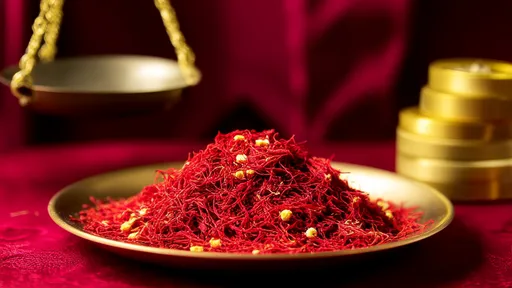
In the hushed, hallowed halls of global spice markets, among sacks of cinnamon and cardamom, exists a commodity traded with the reverence usually reserved for gemstones or precious metals. It is not sold by the pound or the kilogram, but meticulously counted by the individual filament. This is saffron, the world’s most expensive spice, a substance whose value is so intrinsically linked to its profound labor intensity and delicate nature that its price is often discussed in whispers. To understand why a few grams can command a price comparable to gold, one must journey into the sun-drenched fields where it begins, and follow the thread of its production to the market.
The story of saffron’s luxury begins with its biological origin. Crocus sativus, the flower from which saffron is derived, is a sterile triploid. It cannot reproduce without human intervention; it bears no viable seeds. Its propagation is entirely dependent on the manual planting of its corms, or bulb-like stems, by farmers. This fundamental characteristic immediately places it outside the realm of mechanically farmed commodities. Each corm, planted by hand, will eventually produce a few flowers, and each of those flowers will offer up only three delicate, crimson stigma. These vivid red threads are the saffron itself. The rest of the flower—the beautiful purple petals and the yellow styles—are worthless in the spice trade. This minuscule yield per plant is the first cornerstone of its extravagant cost.
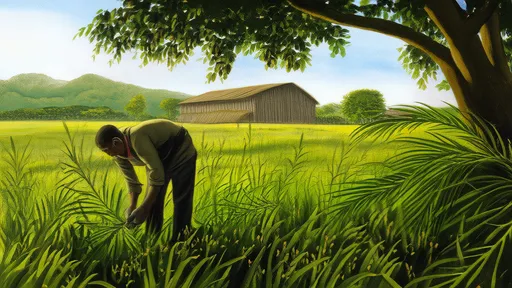
This leads to the second, and most defining, factor: the harvest. The blooming period of the Crocus sativus is brutally short and notoriously unpredictable, often lasting just one to two weeks per year, typically in autumn. The flowers are incredibly delicate; they must be harvested at the precise moment they bloom, early in the morning, before the warmth of the sun can wilt them and degrade the precious stigmas within. This cannot be done by machine. It requires an army of skilled human hands moving with speed and grace across the fields. Imagine a vast field of purple flowers, and dotting among them, hundreds of harvesters bent double, plucking each blossom individually and placing it gently into a basket. The window for this operation is agonizingly narrow, demanding a massive, temporary workforce that must be mobilized and paid for its painstaking labor.
Once harvested, the real magic, and the most labor-intensive phase, begins: the separation. This is where the value is truly extracted, thread by single thread. The tiny, thread-like stigmas must be carefully plucked from each freshly harvested flower. This is a task that defies mechanization. It requires dexterity, patience, and an eagle eye. It is almost universally done by hand, often by women seated together, their fingers moving in a blur of practiced motion to tease out the three precious red strands from each bloom. It is said that to produce a single pound of dry saffron, it requires the harvest of somewhere between 70,000 and 250,000 flowers. The sheer, staggering volume of blossoms needed is a number so large it becomes abstract, yet it is a concrete reality for producers. This meticulous process of separation is why saffron’s cost is so frequently calculated by the individual thread; it is the direct quantification of human effort.
Following separation, the threads must be dried to preserve their potent flavor, aroma, and color-giving properties. This is not a simple matter of leaving them in the sun. The drying process is a critical art form in itself. Too much heat, and the delicate chemical compounds—crocin (for color), picrocrocin (for taste), and safranal (for aroma)—are destroyed. Too little, and the saffron can mold, rendering the entire harvest worthless. Different regions have different traditional methods, from gently toasting over very low embers to careful dehydration in specialized rooms. This crucial step locks in the quality and potency, factors that are directly assessed and priced by expert buyers. Poor drying can turn a fortune into dust, adding another layer of risk and skill to its production.
The economics of this supply chain are unforgiving. The immense input of time, labor, and land for such a tiny output creates a naturally high base cost. A family might spend a full year tending their field of corms, only to have their entire annual income depend on the success of a frantic two-week harvest and the subsequent weeks of delicate processing. This economic reality is reflected in the price. Furthermore, the spice is incredibly lightweight and potent. A few threads are enough to imbue a large paella or biryani with its distinctive golden hue and complex flavor. This potency means a little goes an incredibly long way, justifying, in a way, the high cost per gram. You are not just buying a spice; you are buying tens of thousands of man-hours, generations of tradition, and the very essence of a fleeting autumn bloom, all concentrated into a few grams.
Beyond the practicalities of its production, saffron is steeped in a history of luxury and prestige. Its use dates back over three millennia, mentioned in ancient Egyptian papyri, Greek myths, and Persian royal logs. It was a dye for the robes of kings and monks, a perfume for the halls of Roman emperors, and a medicinal cure-all in medieval Europe. This long-standing association with power, royalty, and the divine has permanently enshrined it as a luxury good. Its value is not merely functional; it is historical and symbolic. To purchase saffron is to buy into this ancient narrative of opulence and rarity.
Finally, the specter of adulteration looms large over the saffron market. Because of its high value, it is a prime target for fraud. Unscrupulous sellers have long tried to pass off inferior products by mixing in look-alikes such as safflower, turmeric-dyed corn silk, or even shredded paper. Sometimes, glycerin is added to increase weight. This widespread fraud creates a market where provenance and trust are paramount. Consumers and professional chefs are often willing to pay a significant premium for saffron from reputable, protected regions like La Mancha in Spain or Kashmir in India, knowing it is pure. This need for guaranteed authenticity further inflates the price of the genuine article, as the cost of certification and brand protection is built into its value.
In conclusion, the question is not simply why saffron is expensive, but how it could possibly be anything else. Its price is the inevitable arithmetic of nature and human effort. It is the sum of counting every single corm planted, every single flower harvested at dawn, every single thread painstakingly plucked, and every careful step in drying and preparation. It is a product that remains gloriously, defiantly human in an age of automation. When you hold a few threads of true saffron in your hand, you are not just holding a spice. You are holding the early morning light of an autumn day, the swift, gentle hands of countless harvesters, and the accumulated weight of three thousand years of history. That is a luxury that can only be measured one delicate thread at a time.
By /Aug 29, 2025
By /Aug 29, 2025
By /Aug 29, 2025
By /Aug 29, 2025
By /Aug 29, 2025
By /Aug 29, 2025
By /Aug 29, 2025
By /Aug 29, 2025
By /Aug 29, 2025
By /Aug 29, 2025
By /Aug 29, 2025
By /Aug 29, 2025
By /Aug 29, 2025
By /Aug 29, 2025
By /Aug 29, 2025

By /Aug 29, 2025
By /Aug 29, 2025
By /Aug 29, 2025
By /Aug 29, 2025
By /Aug 29, 2025
