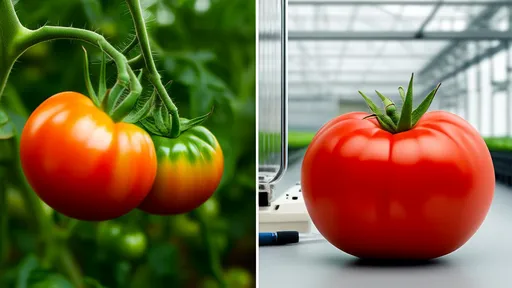
The story of the modern supermarket tomato is a tale of two opposing forces: the quest for perfection and the loss of soul. Walk into any grocery store in the dead of winter, and you'll find bins overflowing with perfectly round, impeccably red fruits. They are a triumph of logistics and agricultural science, able to withstand the brutal physics of cross-country shipping and endure on shelves for weeks. But pick one up, bring it home, and slice it. The experience that follows—a mealy texture, a watery juicelessness, and a profound lack of the sweet, tangy explosion one expects—is the quiet failure hidden within that success. The flavor has been left behind, a casualty in a decades-long war for yield, uniformity, and durability.
The journey to this flavorless present began with the best of intentions. Post-World War II, the global population was booming, and the threat of hunger was a powerful motivator. Agricultural science turned its focus to one primary metric: yield. How could we grow more food on less land, more reliably? For tomato breeders, this meant selecting for plants that produced more and larger fruits. It also meant engineering tomatoes that could be harvested by machine, a development that revolutionized the industry but came with a steep aesthetic price. A machine-harvested tomato needs to be tough; it must detach easily from the vine and survive a tumultuous journey along conveyor belts and into the beds of trucks without splitting or bruising. The tender, thin-skinned heirlooms that burst with flavor were useless in this new industrial system. They were simply too fragile.
Thus, the era of the fortified tomato began. Breeders, through traditional cross-pollination techniques (the precursor to modern genetic modification), started selecting for genes that conferred a thicker, more rubbery skin and a firmer, denser flesh. They prioritized a uniform ripening trait, giving us the perfectly red tomato that lacks the green "shoulders" often seen in heirlooms. This visual consistency was great for marketing but disastrous for taste, as the biochemical pathways that create that ideal color often come at the expense of the sugars and acids that create flavor. Unknowingly, they were making a bargain. In exchange for indestructibility and beauty, they were sacrificing the very compounds that make a tomato worth eating.
The science behind this flavor loss is both complex and elegantly simple. A tomato's flavor is not the work of a single molecule but a sophisticated orchestra of chemicals. The sweet notes come from sugars like fructose and glucose. The tangy, bright acidity comes from citric and malic acids. But the magic, the deep, savory, garden-fresh essence that defines a great tomato, comes from a set of volatile compounds—chemicals that easily evaporate into the air and travel to our olfactory receptors. These volatiles, with names like geranial, beta-ionone, and guaiacol, are the soul of the tomato.
Here lies the crux of the problem. The very genes that breeders worked so hard to instill for the sake of sturdiness and high yield are often directly linked to a dilution of these flavor compounds. The larger a tomato grows, the more its flavor components are watered down. A gene mutation that ensures uniform ripening and a tough skin inadvertently switches off the production of key sugar and volatile compounds. The tomato becomes a handsome container, beautifully engineered for its journey, but tragically empty of what it is supposed to contain.
For decades, consumers, disconnected from the source of their food, accepted this bargain. A tomato was a tomato, a red ingredient in a salad or on a burger, its true potential forgotten by all but gardeners and gourmands. But the tide is turning. The rise of the farmers' market movement, the renewed interest in heirloom varieties, and a growing culinary awareness have created a demand for real flavor. People are once again tasting a sun-warmed Brandywine or a sugary Sun Gold and experiencing a revelation. This is not merely nostalgia; it is a sensory awakening to what has been missing.
This demand has sparked a new quest, a flavor renaissance driven by a coalition of plant geneticists, chefs, and small-scale farmers. Scientists are now using the very tools of modern genetics that once sidelined flavor to now bring it back. They are sequencing the genomes of hundreds of heirloom varieties, cataloging the genetic markers associated with high concentrations of sugars, acids, and prized volatile compounds. This is not a return to the past but a sophisticated merger of old and new. The goal is to introgress these "flavor genes" into modern, robust commercial varieties—to create a tomato that can survive the supply chain but still tastes like it came from a grandfather's garden.
The work is painstaking. It involves detailed chemical profiling and consumer taste panels, marrying hard data to subjective experience. The results, however, are beginning to trickle into the market. Seed companies now offer hybrid varieties bred explicitly for flavor without completely sacrificing yield. Some supermarket chains, under pressure, are partnering with growers who use these new seeds and employ vine-ripening techniques, accepting a shorter shelf life for a better product.
The story of the tomato is a microcosm of our modern food system. It is a reminder that progress, when defined by a single-minded pursuit of efficiency, can have unintended consequences. It shows that taste is not a frivolous luxury but a complex scientific metric that was foolishly ignored. Yet, it is also a story of redemption. It proves that through awareness, demand, and the clever application of science, we can correct our course. The quest to rediscover the lost flavor of the tomato is more than a culinary pursuit; it is a mission to put the soul back into one of our most fundamental foods, and in doing so, reconnect with the true meaning of good taste.
By /Aug 29, 2025

By /Aug 29, 2025
By /Aug 29, 2025

By /Aug 29, 2025
By /Aug 29, 2025
By /Aug 29, 2025

By /Aug 29, 2025
By /Aug 29, 2025
By /Aug 29, 2025
By /Aug 29, 2025

By /Aug 29, 2025
By /Aug 29, 2025
By /Aug 29, 2025
By /Aug 29, 2025
By /Aug 29, 2025

By /Aug 29, 2025
By /Aug 29, 2025
By /Aug 29, 2025
By /Aug 29, 2025
By /Aug 29, 2025
