When we casually refer to coffee beans, we are invoking a culinary and cultural shorthand that belies a fascinating botanical reality. The journey of your morning brew begins not with a bean, but with a fruit—a complex and vibrant drupe that grows on the Coffea plant. To truly appreciate the depth in your cup, one must first understand the journey from a flowering shrub to the roasted seeds we grind.
The Coffea plant is an evergreen shrub, with over 120 species, though the world's coffee economy is predominantly built upon two: Coffea arabica and Coffea canephora (commonly known as Robusta). These plants thrive in the tropical "Bean Belt," a band around the equator that provides the ideal combination of altitude, rainfall, and temperature. The plant's life begins with delicate, jasmine-scented white flowers, whose brief blooming period gives way to the development of the fruit, often called a coffee cherry.
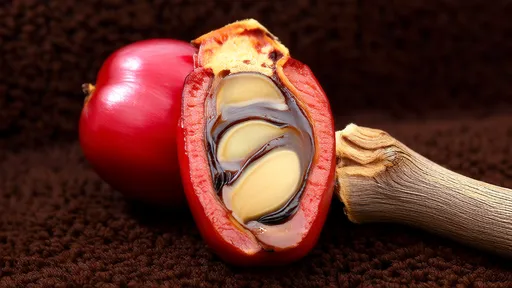
This coffee cherry is the heart of the misconception. Botanically, it is classified as a drupe. A drupe is a type of fruit characterized by a fleshy outer part (the exocarp and mesocarp) surrounding a hard shell (the endocarp or pit) that encases a seed. Familiar examples include peaches, plums, olives, and almonds. In the case of coffee, the cherry's skin (exocarp) starts green and ripens to a deep, vibrant red, yellow, orange, or even pink, depending on the variety. Beneath this skin lies the sweet, mucilaginous pulp (mesocarp). Protecting the prized seeds are two more layers: a slippery parenchyma layer often called the mucilage and a final, tough protective shell known as the parchment (endocarp).
Inside this fortified parchment lie the seeds. Typically, each cherry contains two seeds, nestled with their flat sides together. These are what the world knows as coffee beans. Their shape—oval with one flat side—is a direct result of this growth pattern. On rare occasions, a cherry will produce only a single, round seed, a phenomenon known as a peaberry, which is sometimes separated and sold for its purported concentrated flavor. It is crucial to emphasize that these are seeds, not legumes. They are the embryos of a new coffee plant, packed with nutrients and the chemical precursors to the flavors we cherish.
The process of transforming these seeds into the dry, hard beans we recognize for roasting is a meticulous one. It is primarily about removing all the fruity material that surrounds the seeds. There are two main methods: the natural (dry) process and the washed (wet) process. The natural process is the oldest method, where harvested cherries are simply spread out in the sun to dry. As they dry, the fruit ferments around the seed, often imparting deep, fruity, and wild flavor notes. Once the moisture content is sufficiently low, the brittle outer layers are mechanically hulled away to reveal the green coffee seed within.
The washed process, by contrast, involves de-pulping the cherries soon after harvest to remove the skin and most of the pulp. The seeds, still coated in their sticky mucilage, are then fermented in water tanks for up to two days. This fermentation breaks down the mucilage, which is subsequently washed away. The seeds, still in their parchment hulls, are then dried. This method typically results in a cleaner, brighter, and more acidic cup profile, as it highlights the intrinsic flavor of the seed itself rather than the influence of the fruit.
After drying and hulling, what remains is green coffee. These hard, greenish seeds are stable for transport and storage. It is not until they are roasted that they undergo the Maillard reaction and caramelization, transforming into the fragrant, brown beans we grind. Roasting develops over 800 aromatic compounds, creating the complex spectrum of flavors—from chocolate and nuts to citrus and berries—that define different coffees.
This botanical perspective fundamentally changes our relationship with coffee. The term "bean" is a misnomer that severs the drink from its agricultural and natural origins. Recognizing coffee as the seed of a fruit connects it to the soil, the climate, and the labor that nurtures it. The flavor profile of a final brew is not just a product of a roasting curve or a brewing method; it is a reflection of the cherry's variety, the terroir where it was grown, the weather patterns of that year, and the processing method that preserved its character.
So, the next time you sip your coffee, consider the journey. You are not tasting a bean. You are tasting the carefully processed and roasted seed of a fruit that grew on a tree thousands of miles away. You are tasting the culmination of sunshine, rain, and human effort. Understanding this deep, botanical truth enriches the experience, transforming a simple daily ritual into a moment of connection with the natural world.

By /Aug 29, 2025

By /Aug 29, 2025
By /Aug 29, 2025

By /Aug 29, 2025
By /Aug 29, 2025

By /Aug 29, 2025

By /Aug 29, 2025

By /Aug 29, 2025

By /Aug 29, 2025

By /Aug 29, 2025
By /Aug 29, 2025
By /Aug 29, 2025
By /Aug 29, 2025
By /Aug 29, 2025
By /Aug 29, 2025

By /Aug 29, 2025
By /Aug 29, 2025
By /Aug 29, 2025
By /Aug 29, 2025
By /Aug 29, 2025
