The Cod Wars stand as one of the most peculiar and persistent international disputes of the twentieth century, a series of confrontations that pitted two traditional allies against each other in a battle over fishing rights in the North Atlantic. For over two decades, the United Kingdom and Iceland engaged in a tense and often absurd struggle, where the primary weapon was not the missile or the rifle, but the fishing net and the maritime patrol vessel. It was a conflict born not from ideology or territorial ambition in the traditional sense, but from a fundamental need to protect an economic lifeline. The story of the Cod Wars is a testament to how a seemingly minor resource can escalate into a matter of national sovereignty and pride, drawing in navies, threatening NATO cohesion, and reshaping international maritime law.
To understand the ferocity of the dispute, one must first appreciate the centrality of cod to Iceland. For centuries, the fish was the cornerstone of the nation's economy and diet. Its export revenues funded the country's development and modernization. By the mid-20th century, as global fishing technology advanced with factory trawlers and sonar, concerns grew in Reykjavik that foreign fleets, particularly the vast British trawler fleet, were overfishing the stocks upon which Icelandic livelihoods depended. The Icelandic government concluded that its survival as a nation was intrinsically linked to the survival of the cod stocks in its surrounding waters. This was not merely an economic calculation; it was an existential one.
The conflict unfolded in three distinct phases, each triggered by Iceland's unilateral extension of its exclusive fishing limits. The First Cod War erupted in 1958 when Iceland declared a 12-nautical-mile exclusive fisheries zone. The UK refused to recognize the extension, and the Royal Navy was dispatched to protect British trawlers operating inside the new limit. What followed was a bizarre game of maritime chicken. Icelandic Coast Guard vessels, small and nimble, would attempt to cut the warps (the cables towing the trawls) of British ships. Royal Navy frigates would then manoeuvre to shield the trawlers, leading to tense standoffs and occasional ramming incidents. No shots were fired, but the sea became a stage for calculated aggression and naval brinkmanship.
A decade later, the Second Cod War began in 1972 with Iceland's audacious expansion to a 50-nautical-mile limit. This move was met with even greater resistance from London. The British government again deployed a protective fleet, this time larger and more determined. The confrontations grew more intense and dangerous. The Icelandic Coast Guard, now equipped with specially designed warp-cutters, became more adept at their task. The most famous tool of this conflict was the Ægir, an Icelandic gunboat that earned a formidable reputation for its aggressive tactics. Ramminɡ became a standard tactic, with ships on both sides sustaining significant damage. The situation escalated from a fisheries dispute to a genuine international crisis, straining the diplomatic bonds between the two NATO allies to a breaking point.
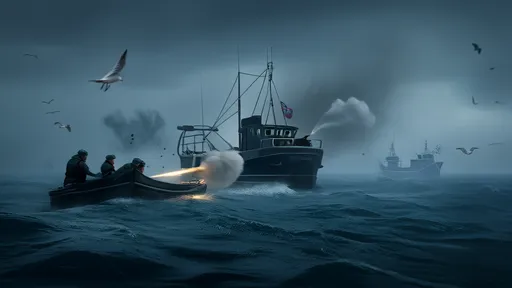
The final and most severe chapter, the Third Cod War, commenced in 1975 with Iceland's most ambitious declaration: a 200-nautical-mile Exclusive Economic Zone (EEZ). This was a direct challenge to the entire international order of the seas. The UK, supported by West Germany, categorically rejected the move. The Royal Navy assembled its largest protection fleet yet, including frigates, supply vessels, and tugs, to safeguard a fleet of about forty British trawlers. The Icelanders, though massively outgunned, refused to back down. Their strategy was one of asymmetric warfare on the high seas. Coast Guard ships, like the Þór, repeatedly rammed British warships many times their size, creating iconic images of the conflict. Beyond the physical clashes, Iceland wielded a powerful diplomatic weapon: it threatened to withdraw from NATO and expel the critical US military base at Keflavík, a cornerstone of Western defence against Soviet submarines during the Cold War.
This ultimatum changed everything. The United States, fearing a catastrophic gap in the GIUK Gap (Greenland-Iceland-UK Gap) defence line, applied immense pressure on the British government to concede. With NATO unity at stake and no clear end in sight to the costly naval deployments, the UK was forced to the negotiating table. In 1976, a humiliated Britain agreed to a settlement. It recognized Iceland's 200-mile zone in exchange for a temporary allowance for a limited number of British trawlers to fish within it, an allowance that was phased out within two years. Iceland had won a total victory.
The ramifications of the Cod Wars extended far beyond the cold waters of the North Atlantic. Iceland's success served as a catalyst for a global movement. Developing nations with rich coastal resources saw Iceland's defiance as a blueprint for reclaiming control from distant-water fishing powers. This momentum was crucial in the United Nations Conference on the Law of the Sea (UNCLOS), which eventually formalized the 200-nautical-mile EEZ as a standard principle of international law in 1982. In a profound twist, the stubborn fight of a tiny island nation had rewritten the rules of the ocean for the entire world, granting coastal states unprecedented authority over their maritime resources.
Today, the Cod Wars are remembered as a classic example of how a small nation can leverage strategic importance and sheer determination to overcome a much larger adversary. For Iceland, the conflict cemented its identity as a fiercely independent state willing to defend its interests at all costs. The victory ensured its economic sovereignty for generations. For Britain, it was a frustrating and embarrassing episode that demonstrated the limits of naval power in a modern geopolitical context. The legacy of the Cod Wars is etched not only in the hulls of the ships that were rammed but in the very law of the sea, a lasting reminder that sometimes, the most consequential battles are fought not for gold or glory, but for fish.

By /Aug 29, 2025

By /Aug 29, 2025

By /Aug 29, 2025

By /Aug 29, 2025

By /Aug 29, 2025

By /Aug 29, 2025

By /Aug 29, 2025

By /Aug 29, 2025

By /Aug 29, 2025

By /Aug 29, 2025

By /Aug 29, 2025

By /Aug 29, 2025
By /Aug 29, 2025

By /Aug 29, 2025

By /Aug 29, 2025
By /Aug 29, 2025
By /Aug 29, 2025

By /Aug 29, 2025

By /Aug 29, 2025

By /Aug 29, 2025
